


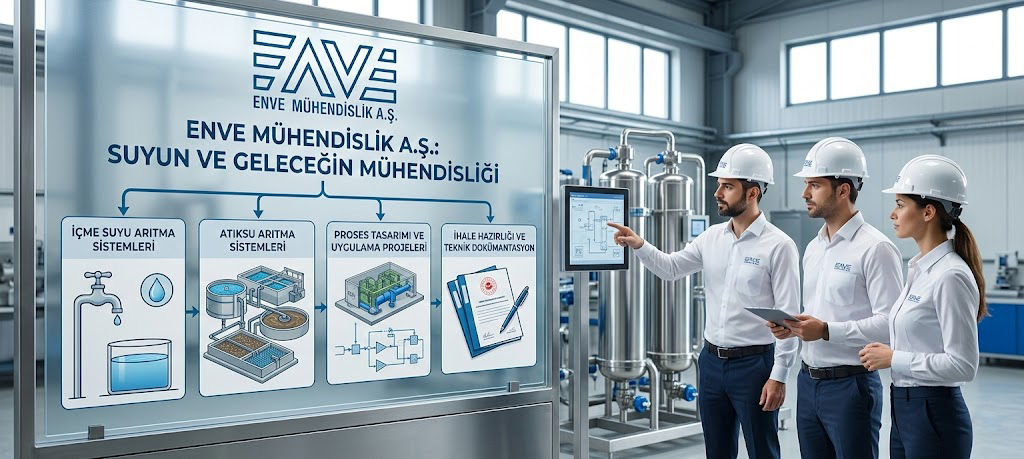
Raw water analysis evaluation is the most fundamental engineering study conducted to determine the physical, chemical, and microbiological properties of a water source and to verify its suitability for its intended use. Whether it is the drinking water need of a residence or the production line of a massive factory; it is impossible to develop a correct treatment strategy without knowing the character of the water. As Enve Engineering, we use analysis results as a roadmap in the evolution of raw water from its crude state until it reaches the tap or the machinery.
In the modern world, the biggest mistake made when choosing drinking water treatment systems is a superficial examination of analysis reports. However, the answer to the question how to read a water analysis report is the secret key that reduces investment costs and extends system life. Dissolved solids, suspended particles, and invisible microorganisms in the water directly affect the design of the system.
What are Raw Water Analysis Parameters?
The raw water analysis parameters that need to be examined to understand the potential of a water source vary according to the source (well, mains, river, or sea). In a general evaluation; in addition to physical properties such as turbidity, color, odor, temperature, and dissolved oxygen, chemical components must also be meticulously examined.
pH and Conductivity Balance of Water
The pH and conductivity balance of water allows us to understand whether the water is corrosive or scale-forming. A pH value below 7 indicates that the water is acidic and can damage pipelines, while high pH values can cause lime precipitation. Electrical conductivity is an indicator of the total amount of ions in the water and is the most critical data in the design of advanced treatment technologies such as reverse osmosis.
Industrial Water Analysis Criteria and Process Efficiency
In industrial plants, water is not only a consumable but also a raw material. Industrial water analysis criteria can be much stricter than domestic use standards. Especially in high-pressure boilers or sensitive textile dyeing processes, process water quality parameters must be monitored second by second. Enve Engineering provides energy savings by optimizing the water cycle of industrial facilities.
Total Hardness Determination and Interpretation
Total hardness determination and interpretation is performed specifically to measure the concentration of calcium and magnesium ions. Hard water causes clogging of heat exchangers in industry and increases detergent consumption in homes. This value, expressed in units of French hardness or German hardness, is the fundamental basis for determining the capacity of a water softener. During the raw water analysis evaluation process, hardness is the main factor determining the amount of resin.
Anion-Cation Balance Calculation in Water Analysis
To verify the accuracy of the results coming from the laboratory, the anion-cation balance calculation method is used in water analysis. In nature, water is electrically neutral. Therefore, the total milliequivalent amount of positively charged cations (Calcium, Magnesium, Sodium) must be equal to the total of negatively charged anions (Chloride, Sulfate, Bicarbonate). If this balance deviates by more than 5-10%, there is either an error in the analysis or a significant mineral concentration that has not been measured.
Drinking Water Standard Values Table
The drinking water standard values table, established to protect human health, is based on the criteria of the World Health Organization (WHO) and the Ministry of Health “Regulation on Water for Human Consumption.” Exceeding the limit values in this table indicates that direct consumption of the water is risky.
| Parameter | Unit | Maximum Permissible Limit |
|---|---|---|
| pH | – | 6.5 – 9.5 |
| Conductivity | µS/cm | 2500 |
| Turbidity | NTU | 1.0 |
| Chloride | mg/L | 250 |
| Sulfate | mg/L | 250 |
| Nitrate | mg/L | 50 |
Heavy Metal Analysis Limits
The heavy metal analysis limits, which emerge as a result of the pollution of water resources by industrial wastes or underground layers, are of vital importance. Elements such as arsenic, lead, mercury, and cadmium can create toxic effects even at very low concentrations (at ppb levels). If the presence of these elements is detected during raw water analysis evaluation, special selective resins or activated carbon filtration must be included in the system designs.
Well Water Analysis Evaluation Process
For well water, which is much more variable than mains water, the well water analysis evaluation procedure must be more comprehensive. Seasonal rainfall, agricultural fertilization activities, and septic leaks in the vicinity can suddenly change the chemistry of well water. Therefore, monitoring the amount of organic matter and total dissolved solids (TDS) in well water should be done regularly.
Microbiological Water Analysis Limit Values
It is not enough for water to be only chemically clean. Microbiological water analysis limit values inspect whether pathogenic organisms are present in the water. The number of Escherichia coli and Coliform bacteria must be “0” (zero) in drinking water. If these values are above the limits, ultraviolet sterilization or chlorine dosing units must be commissioned. Enve Engineering offers safe disinfection solutions that eliminate microbiological risks.
System Design Following Raw Water Analysis Evaluation
After the analysis stage is completed, it is time for engineering design. Based on raw water analysis evaluation data; sand filters, activated carbon units, softening systems, and at the final stage, Reverse Osmosis devices are selected. The removal efficiency of each ion and particle from the water is calculated according to water chemistry principles.
In conclusion, a high-quality water treatment project is only possible with a correct raw water analysis evaluation. Enve Engineering, with its professional team, meticulously examines your analysis reports and offers the most suitable technological solution you need. Remember that an incorrectly designed system causes both water loss and high operating costs. The water analysis report is the most valuable document determining the future of your investment.
If you have a water analysis report and are wondering what it means technically, you can contact our expert engineers. We are by your side for all your needs regarding drinking water standards and industrial water quality.